📖 Overview
This portfolio is not just about building a simple login feature. It highlights security awareness by showcasing the use of security headers. In this way, the application is not only functional but also educational, demonstrating how a backend system can protect users from common web threats.
🌍 Why Security Headers Matter
Security headers are the first line of defense sent from the server to the browser. They: - Control how content is displayed and interpreted. - Prevent common attacks such as XSS, clickjacking, and MIME sniffing. - Provide transparency to developers and reviewers about the security practices in place.
Want to improve your application hygiene overall? Read Why Documentation Matters in Application Development for foundational best practices.
🛡️ Headers Implemented
This portfolio demonstrates several important headers:
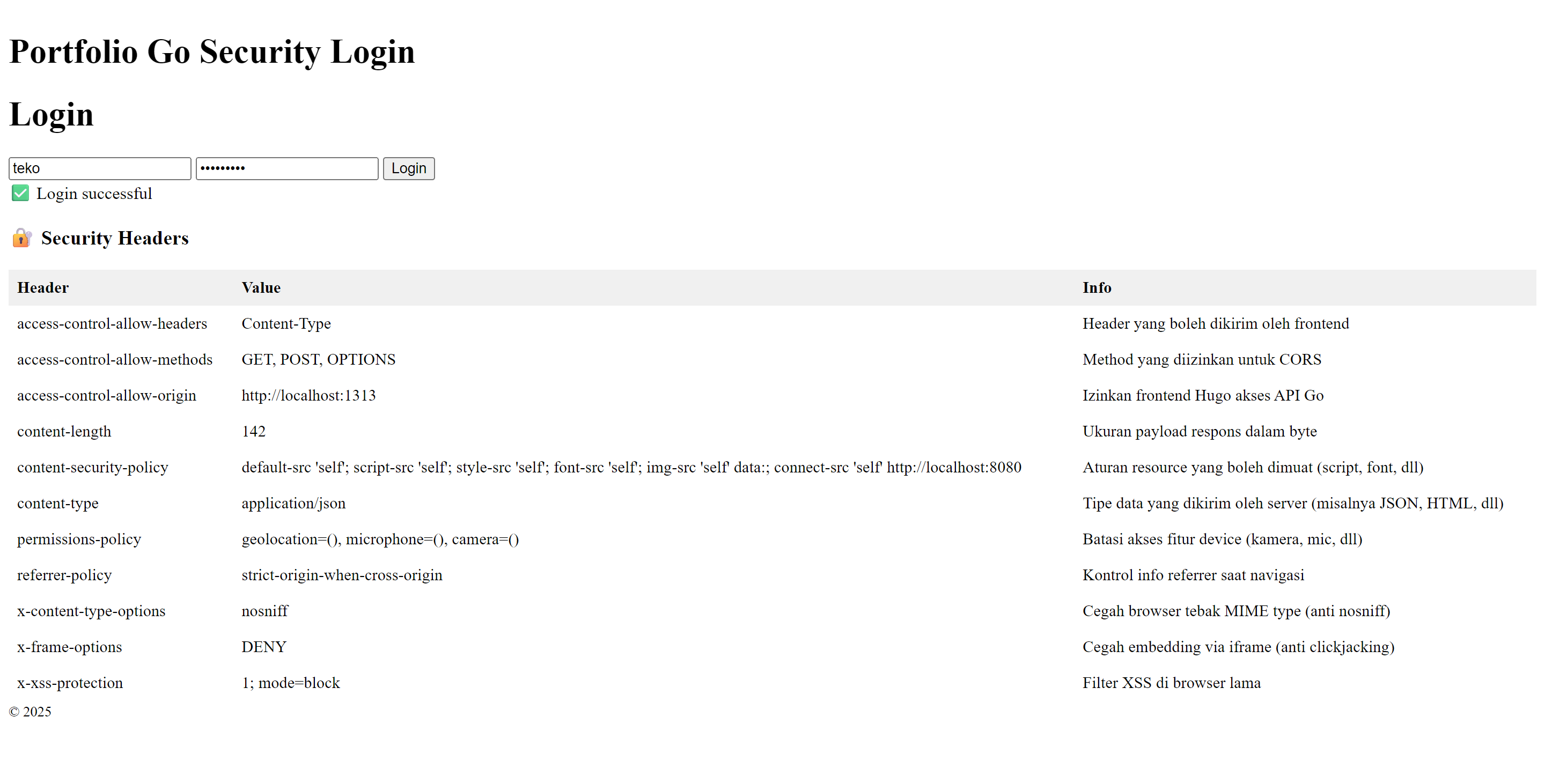
- X-Content-Type-Options → Prevents browsers from guessing content types (anti MIME sniffing).
- X-Frame-Options → Protects against clickjacking by blocking iframe embedding.
- X-XSS-Protection → Enables XSS filters in older browsers.
- Content-Security-Policy (CSP) → Defines which resources can be loaded (scripts, fonts, images, etc.).
- Referrer-Policy → Controls what referrer information is shared during navigation.
- Permissions-Policy → Restricts access to device features such as camera, microphone, and location.
- CORS Headers → Ensures secure communication between the Hugo frontend and the Go backend.
- Access-Control-Expose-Headers → Allows frontend JavaScript to read all headers for educational purposes.
🎓 Educational Value
The main goal of this showcase is not production-level security, but rather: - Learning: Understanding the role of each header and its impact on web security. - Transparency: Showing reviewers or clients that the developer is aware of security practices. - Portfolio Value: Adding depth to the project by highlighting security aspects often overlooked.
🧩 How It Looks
After a successful login, users don’t just see a status message. They also see a table listing all security headers sent by the server, each with a short explanation. This transforms the portfolio into an interactive educational tool.
🚀 Conclusion
This portfolio emphasizes that security is an integral part of application development, not an optional add-on. By presenting security headers in full detail, the developer builds not only a functional application but also raises awareness about the importance of modern security practices.