I’ll never forget the look on the CFO’s face during my first major project review. We were implementing a new financial module, and I had just explained a technical constraint in the approval workflow using jargon about database triggers and API latency. His expression shifted from confusion to frustration. "I don't care about the how," he said. "I need to know if my team can close the books on the 5th, not the 15th." That was my turning point. I realized my job as an IT Analyst wasn't to explain technology to finance; it was to translate financial imperatives into technical reality and vice versa.
In the decade since, I've worked at this intersection, helping organizations navigate ERP implementations, automate core processes, and turn regulatory challenges into system features. The modern IT Analyst in finance is a strategic interpreter, a process architect, and a risk mitigator. This guide breaks down exactly how this role operates, why it's critical, and the tangible value it delivers.
The Core Mission: Translation, Not Just Implementation
Finance speaks the language of compliance, risk, liquidity, and reporting deadlines. Technology speaks the language of systems, data, APIs, and scalability. Miscommunication here isn't just inconvenient; it's expensive. A misunderstood requirement can lead to a system that passes technical tests but fails an audit.
The IT Analyst's primary function is to ensure these two domains understand each other perfectly. We do this by becoming bilingual: * We understand PSAK, IFRS, GAAP, SOX, and AML/KYC regulations enough to know what controls a system must enforce. * We understand relational databases, microservices, and integration patterns enough to design a system that can enforce those controls efficiently.
The Finance Technology Stack: Where Analysts Operate
To understand the role, you must understand the landscape. Modern finance technology is a layered ecosystem:
- Core ERP & Financial Systems: The system of record (e.g., SAP S/4HANA, Oracle Fusion, Microsoft Dynamics, NetSuite, Odoo). This houses the General Ledger (GL), Accounts Payable (AP), Accounts Receivable (AR), and Asset Management.
- Specialized Platforms: Best-of-breed tools for specific functions (e.g., Coupa for procurement, BlackLine for reconciliation, Adaptive Insights for planning).
- Integration & Automation Layer: Middleware (like MuleSoft, Boomi), Robotic Process Automation (RPA), and APIs that stitch everything together.
- Analytics & Reporting Layer: BI tools (Tableau, Power BI) and data warehouses that sit atop the operational systems.
The IT Analyst must comprehend how a requirement in Layer 1 (e.g., "automate foreign currency revaluation") impacts data flows in Layer 3 and reporting in Layer 4.
The Analyst's Toolkit: Key Responsibilities in Action
Our work isn't abstract. It follows the lifecycle of financial processes. Let's use the critical Procure-to-Pay (P2P) cycle as a living example.
Phase 1: Requirement Discovery & Translation
The finance team says: "We need to prevent duplicate payments and ensure all invoices have a valid purchase order." * The Analyst's Translation: This requires: 1. A three-way matching engine (PO, Goods Receipt Note, Invoice). 2. A configurable approval matrix based on amount, department, and vendor. 3. Data validation rules at the invoice entry point (vendor ID, PO number). 4. An audit trail logging every change and approval for SOX compliance. * Deliverable: A detailed Business Requirements Document (BRD) or User Stories with acceptance criteria that both finance and tech teams sign off on.
Phase 2: Process Design & Workflow Mapping
Here, we move from what to how. We map the ideal future state. * Activity: Creating Business Process Model and Notation (BPMN) diagrams, like the one referenced in the original article. This visual language shows every swimlane (Procurement, Finance, System), decision gateways ("Is PO approved?"), and system automations. * Outcome: A clear blueprint that shows where human judgment is needed and where the system can automate. This eliminates ambiguity and becomes the single source of truth for developers.
Phase 3: Solution Design & Vendor Liaison
Now we choose and configure the tools. * Build vs. Buy Analysis: Should we customize the ERP's AP module, or integrate a specialized platform like Coupa? The analyst models TCO, complexity, and strategic fit. * Configuration Specification: Documenting exactly how fields, workflows, and rules must be set up in the chosen system. * Integration Design: Specifying how the financial system will talk to the bank for payments, the procurement system for POs, and the data warehouse for reporting.
Phase 4: Testing, Validation, & Compliance Assurance
This is where technical confidence meets financial rigor. * User Acceptance Testing (UAT) Scripts: The analyst designs test cases that mirror real-world finance scenarios: "Test 1: Submit an invoice without a PO. Expected Result: System blocks with error X." * Control Validation: Working with internal audit to ensure the configured system actually enforces the mandated financial controls. Does the system prevent someone from approving their own purchase order? Can journal entries be changed after closing without a trace? * Data Migration Strategy: Planning the secure, accurate move of legacy financial data (open POs, vendor master data) into the new system.
Phase 5: Knowledge Transfer & Continuous Improvement
Go-live isn't the end. * Documentation: Creating Standard Operating Procedures (SOPs) and system guides for finance users, not IT. * Training: Conducting role-based training sessions. * Post-Launch Optimization: Monitoring system use, gathering feedback, and identifying the next automation opportunity (e.g., using AI/ML for invoice data capture or predictive analytics for cash flow).
Curious how analytics drives decision‑making across teams? Explore Data Analytics in Marketing Examples for practical cross‑department insights.
6. Short Case Study
Example implementation in Odoo ERP:
- A Purchase Order is created → automatically flows into the invoice module → the system performs a 3-way match → payment is processed via bank API integration.
Result: faster processes, fewer errors, and a clear audit trail.
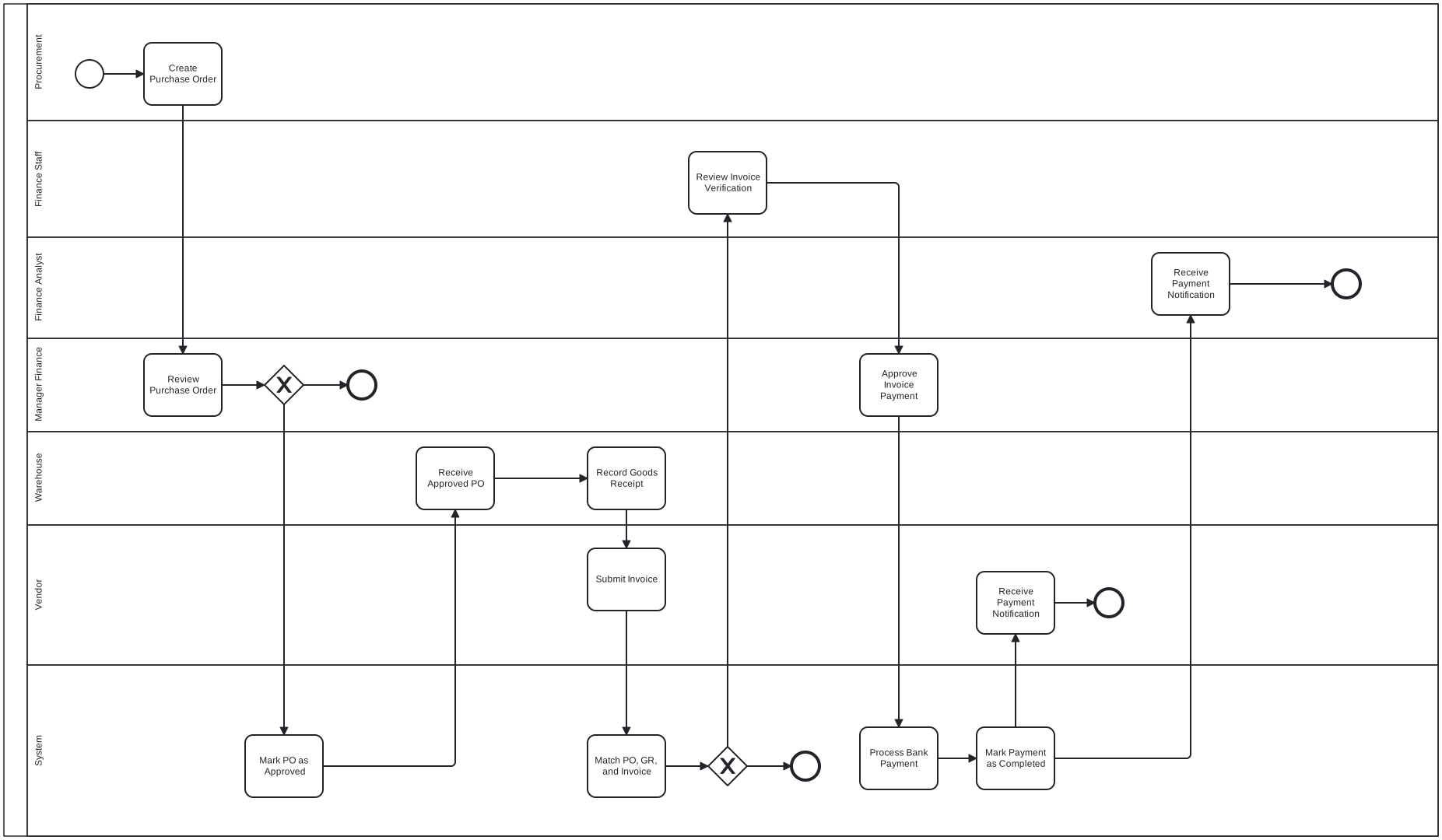
7. 🧭 Business Proccess Modeling Notation (BPMN) Narrative
| Swimlane / Role | Flow Description |
|---|---|
| Procurement | StartEvent → Process begins in Procurement. Create Purchase Order → Procurement issues a PO. Flow → Arrow directed to Manager Finance. |
| Manager Finance | Review Purchase Order → Manager Finance receives PO. Decision (Gateway) → Is PO approved? If Approved → Flow continues to System (Mark PO as Approved). If Rejected → Flow goes to EndEvent in Manager Finance. |
| System | Mark PO as Approved → System updates PO status. Flow → Arrow directed to Warehouse. |
| Warehouse | Receive Approved PO → Warehouse acknowledges approved PO. Record Goods Receipt → Warehouse records goods received. Flow → Arrow directed to Vendor. |
| Vendor | Submit Invoice → Vendor sends invoice based on delivered goods. Flow → Arrow directed to System. |
| System | Match PO, GR, and Invoice → System performs 3-way match. Decision (Gateway) → Is invoice valid? If Valid → Flow continues to Finance Staff. If Not Valid → Flow goes to EndEvent (invoice rejected). |
| Finance Staff | Review Invoice Verification → Finance Staff reviews matching results. Flow → Arrow directed to Manager Finance. |
| Manager Finance | Approve Invoice Payment → Manager Finance authorizes payment. Flow → Arrow directed to System. |
| System | Process Bank Payment → System executes payment via bank. Mark Payment as Completed → System updates payment status. Flow → Arrow branches to Vendor and Finance Analyst. |
| Vendor | Receive Payment Notification → Vendor receives confirmation of payment. Flow → Arrow directed to EndEvent. |
| Finance Analyst | Review Financial Report → Finance Analyst reviews financial reports. Flow → Arrow directed to EndEvent. |
The Essential Technologies an Analyst Must Understand
To be effective, an analyst doesn't need to code, but must grasp capabilities and limitations:
| Technology | Relevance to Finance | Analyst's Focus |
|---|---|---|
| ERP/Financial Suites (SAP, Oracle, etc.) | Core system of record. | Module functionality, configuration options, reporting tools, and upgrade impact. |
| RPA (UiPath, Blue Prism) | Automates high-volume, repetitive tasks (invoice entry, reconciliation). | Process selection, exception handling design, and control framework for "bots." |
| API & Microservices | Enables real-time integration with banks, tax systems, marketplaces. | Defining data payloads, error handling, and security requirements (authentication, encryption). |
| AI/ML & OCR | Automates data extraction from invoices/receipts; detects anomalies. | Defining training data needs, validating accuracy rates, and designing human-in-the-loop review for exceptions. |
| Blockchain / DLT | For transparent, immutable audit trails in complex trade finance or inter-company transactions. | Understanding use-case applicability versus traditional databases. |
| Cloud Platforms (AWS, Azure, GCP) | Hosting modern financial applications. | Understanding shared responsibility model, data residency laws, and disaster recovery implications for financial data. |
Navigating Modern Challenges: The Analyst as Problem-Solver
The landscape is never static. Key challenges include:
- Regulatory Tsunami: Keeping pace with evolving regulations (e.g., ESG reporting mandates, crypto asset accounting) and interpreting them as system requirements.
- Legacy System Integration: Building secure, real-time bridges between modern cloud applications and decades-old mainframe GL systems.
- Cybersecurity & Fraud: Designing systems with Zero Trust principles—ensuring strict role-based access, encryption, and anomaly detection are baked in, not bolted on.
- The Scalability Imperative: Systems must handle month-end close for 100 users and potential M&A activity that doubles transaction volume overnight.
The Value Proposition: Why This Role Pays for Itself
A skilled IT Analyst in finance delivers measurable ROI:
- Risk Reduction: Prevents costly compliance failures and audit findings by building controls into the system.
- Efficiency Gains: Identifies and automates manual processes, freeing finance staff for analytical work. (e.g., Automating 3-way matching can reduce invoice processing cost by 70%).
- Improved Decision-Making: Ensures data integrity and enables real-time reporting, giving leadership a accurate, timely financial picture.
- Project Success: Dramatically increases the likelihood that technology projects (ERP implementations, automation initiatives) are delivered on time, on budget, and actually adopted by the finance team.
Key Takeaways for Finance and IT Leaders
- The Analyst is a Strategic Partner, Not a Order-Taker: Involve them during strategic planning, not after software is selected.
- Business Acumen is Non-Negotiable: The best finance IT Analysts have taken accounting courses or have deep domain experience.
- Communication is the Core Skill: The ability to write clear stories, draw clear diagrams, and facilitate workshops is more important than knowing a specific programming language.
- Invest in This Role: Under-investing in quality analysis is the leading cause of multi-million dollar ERP and automation project failures.
Frequently Asked Questions (FAQ)
What is the primary distinction between an IT Analyst in finance and a Financial Systems Analyst?
While the terms are often used interchangeably, the difference usually lies in their origin and focus. An IT Analyst typically comes from a computer science or information systems background, focusing on infrastructure, security, and how various systems talk to each other. A Financial Systems Analyst often begins in accounting or finance, bringing deep knowledge of the general ledger and focusing on ERP configuration and financial reporting compliance.
How much technical coding knowledge is actually required for these roles?
Production-level coding is rarely a requirement, as the primary output is documentation and system design. However, a "technical literacy" is essential. Being able to write SQL queries to audit data, understanding the logic of APIs for system integrations, and knowing enough scripting to automate simple tasks are the skills that separate average analysts from high-performers.
What specific metrics define a successful system implementation for a finance team?
Success is measured by the efficiency of the finance department rather than just system uptime. Key indicators include a significant reduction in the time it takes to close the monthly books, a decrease in the number of manual journal entries, and a reduction in audit findings. If the finance team is spending less time on data entry and more time on analysis, the analyst is succeeding.
Why is "organizational isolation" considered the biggest threat to this role's effectiveness?
If an IT Analyst is isolated within the IT department, they lose touch with the daily reality of the finance team. They may build technically perfect systems that are practically useless for accounting workflows. Effective analysts are usually embedded within the finance department, attending their stand-ups and month-end reviews to identify real-world pain points as they happen.
What are the most common long-term career trajectories for a Finance IT Analyst?
The path is highly versatile. Many move into Finance Technology Management or become Directors of Financial Systems. Others move into Enterprise Architecture, where they design the tech blueprint for the whole company. Those who enjoy the business side often move into consulting or product management for Fintech companies, helping build the next generation of financial software.
That frustrated CFO years ago was right. He didn't need a technologist; he needed a bridge. The most sophisticated system is worthless if it doesn't help close the books faster, assure compliance, or provide strategic insight. The modern IT Analyst is that essential connective tissue. By mastering the language of both realms, we don't just implement software we engineer trust, efficiency, and clarity into the very financial backbone of the organization. In an era defined by digital transformation, this role isn't just important; it's indispensable.